Commercial Service

Cubicle Disassembly and Reassembly in Greater Boston

Panel stations taken apart in a recorded sequence, moved through freight elevators and 128 or 495 docks, and rebuilt to plan for your electrician and IT vendor.

(774) 421-9389
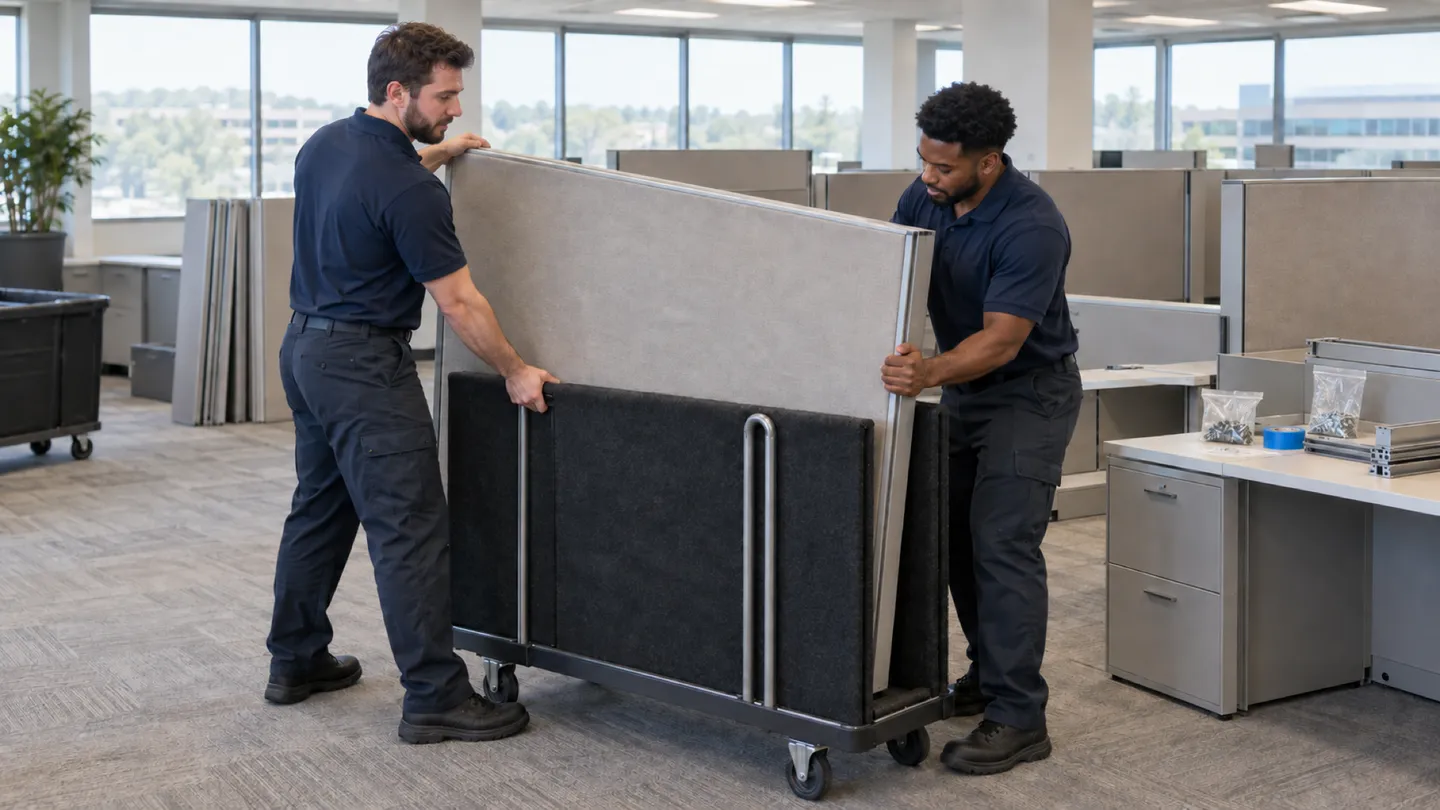
Cubicle Disassembly & Reassembly moving in Boston and MetroWest: moving crew at work
  • Licensed & Insured Fully Covered
  • Owner-Operated By Tyler Trefrey
  • 10 States Northeast Served

Start your free commercial move quote

verified For estimate purposes only credit_card_off No credit card required

How We Plan Cubicle Disassembly & Reassembly

In a Financial District tower or a Route 128 office park, cubicles are usually the last thing standing and the first thing staff notice. A station that comes back wobbly, short a bracket, or in the wrong spot shows up on Monday morning. The fix is settling the order before the first screw comes out.

We record a teardown sequence for each station type on your floor and follow it every time: toppers and overhead bins come off, then worksurfaces and pedestals, then panels and posts, then base raceways. Each station is numbered to match the new plan and photographed first, and its hardware goes into a bag carrying that number, so fasteners do not mix between stations. On the new floor the crew works the plan station by station in reverse order. Power whips are the electrician's, data drops are the IT vendor's, and warranty items go back to your furniture dealer. The rest of a suite relocation is covered on our office moving page.

Who usually signs off
Facilities manager or office manager, holding the furniture dealer's plan and lining up the electrician and IT vendor
Timing that works
Evening or weekend teardown on request, since many Boston towers keep drilling out of business hours, with a snow date from December into March and the late-August lease rush avoided where possible.

What typically moves

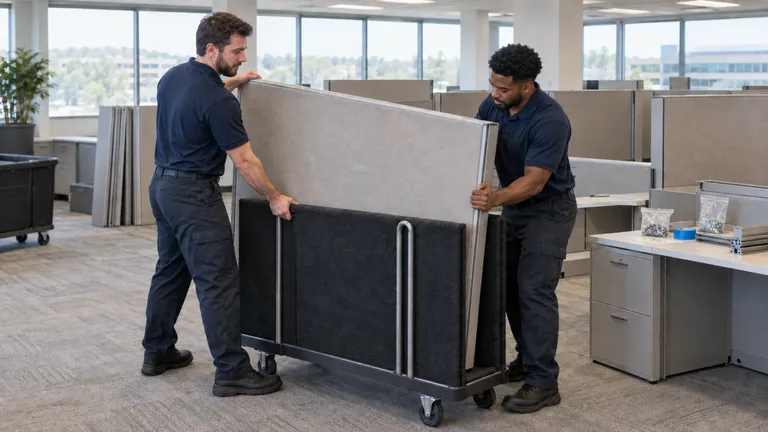
  • Tackable fabric panels and connector posts Panels stand in padded carts; each station's connectors and end caps are sealed into its numbered bag.
  • Hanging worksurfaces and return tops Brackets come off with the surface and are taped beneath it; corners are guarded for tight elevator lobbies.
  • Rolling and fixed pedestals Drawers locked or emptied, as you prefer; keys go into envelopes labeled by station.
  • Overhead storage and glass privacy toppers Removed before anything else; toppers ride in cartons and are not stacked flat against panels.
  • Base raceway sections and harnesses Tagged and carried as parts. Nothing is rewired, and the whip at the floor stays with the electrician.
  • Task lights, monitor arms and keyboard trays Clamped to their home surface or bagged with the station they came from.

Access and scheduling

In Boston, the freight elevator sets the pace. Towers in the Financial District, Back Bay and around Post Office Square book the car and the dock in blocks, often evenings or weekends, and management usually asks for a certificate of insurance before confirming, which we can provide on request. We ask for the car's inside height and door width, because a panel taller than the car goes in on an angle, which cuts how many fit each trip. If the truck needs the curb rather than a dock, the city's street-occupancy permit has to be in hand.

Suburban parks at Needham Crossing and in Westwood, Marlborough and Hopkinton usually offer a ground-level door and a longer carry instead, a short drive from our Franklin base. Around September 1, curbs and elevators near Cambridge and Somerville fill with apartment moves, so we steer office work away from that week when we can. Snow season adds shoveled paths and a backup date.

Protection and handling

Panel faces rarely break; edges, corners and hardware bags do. Every worksurface gets corner guards, glass toppers travel boxed, and fabric panels are wrapped against the salt and grime a truck floor picks up in a Massachusetts winter. Door frames, elevator walls and carpet along the route get pads and runners.

While stations come apart, the crew fills in a station sheet listing chipped edges, bent brackets and connectors that were already missing. You get it the same day, so your furniture dealer can sort out warranty items and order parts before the rebuild date. On the new floor every run is checked for plumb and every surface for level, and raceway covers stay off where the trades need them, so the electrician can connect whips and the IT vendor can bring up data drops.

Who does what

Some of this job belongs to other trades. The written plan names each one.

Power whips and the building connection
A licensed electrician. Whips are unhooked ahead of teardown and made live again, with a test, once the stations stand; we carry harness sections as tagged parts.
Low-voltage cabling and data drops
Your IT vendor or cabling contractor clears them ahead of teardown and terminates them once stations stand.
Warranty items, added components and the drawing
Your furniture dealer or designer. We rebuild to their drawing and list any part they need to order or replace.

Not part of our work

  • Rewiring harnesses or making any connection to building power, which is the electrician's job.
  • Layout design, ordering components, or deciding what the manufacturer's warranty covers.

Around Boston and MetroWest

Panel floors turn up in older Financial District and Downtown Crossing towers, at Crown Colony in Quincy, around Needham Crossing and University Station in Westwood, and in the Marlborough, Hopkinton and Southborough office parks along I-495. Towers push the work into off-hours; suburban parks trade that for longer carries from shared loading doors, and our Franklin base sits close to the 495 side.

The crew that shows up

Two Eastside Movers crew members outside a client's red front door

Cubicle Disassembly & Reassembly FAQs

Another question? Call (774) 421-9389.

Our Back Bay building limits freight to evenings. Can teardown and rebuild fit that window?

Usually, over several evenings or a weekend on request. We plan each night's zone to end with stations either fully standing or fully packed, so nothing is left half-built on a floor your staff use the next morning. The elevator block is the building's call, and we size the crew to fit it.

We are moving cubicles from Cambridge to Marlborough. Do the stations need new hardware?

Not usually. Each station's hardware travels in its own numbered bag, so the rebuild in Marlborough uses the fasteners that came out in Cambridge. New hardware comes in when the plan changes a layout, and your furniture dealer supplies it. The Mass Pike drive adds time between teardown and rebuild, which we build into the schedule.

Who takes care of the whips and data drops under our stations?

Two separate trades. A licensed electrician unhooks the power whips before the crew arrives and restores them after the rebuild, testing each one, and your IT vendor handles the data drops in the raceways. Our crew carries harness sections as tagged parts. Booking both for rebuild day keeps finished stations from sitting without power or network.

Some of our stations are still under warranty. How does that work with a move?

Talk to your furniture dealer before teardown. Some manufacturers want their dealer to see existing damage or handle certain parts. We record each station's condition on the teardown sheet with photos, anything under warranty goes to the dealer, and we rebuild the rest to the plan.

Plan your business move

Tell us both addresses, the building rules you know about, and the dates you cannot move. We will send back a written plan and estimate.

Call (774) 421-9389

Mon–Sat 8:00 AM – 5:00 PM

Call Now call 774-421-9389