Commercial Service

Modular Workstation Moving in Boston and MetroWest

Freestanding benching and sit-stand desks taken apart in manageable sections, moved, and assembled to your approved seating plan.

(774) 421-9389
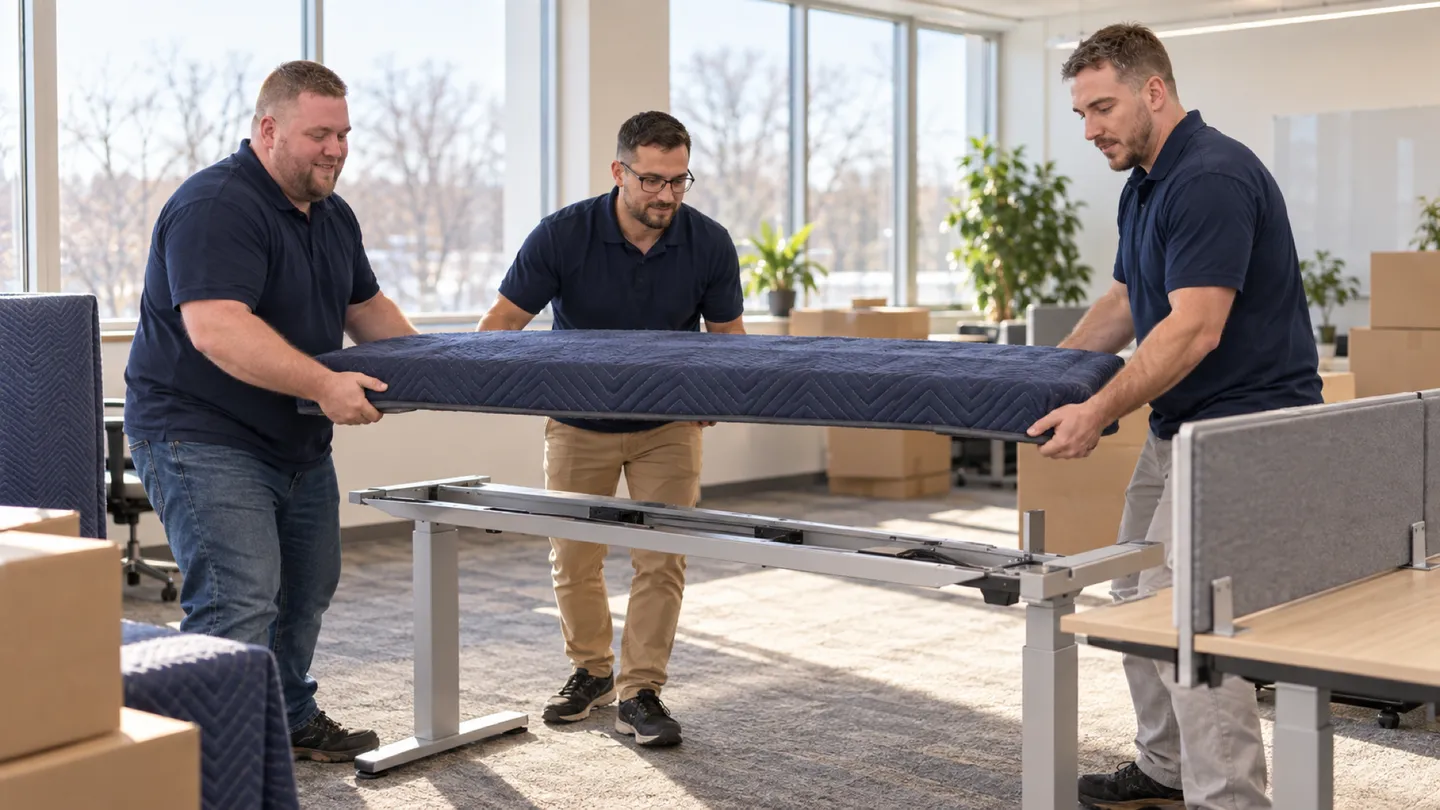
Modular Workstations moving in Boston and MetroWest: moving crew at work
  • Licensed & Insured Fully Covered
  • Owner-Operated By Tyler Trefrey
  • 10 States Northeast Served

Start your free commercial move quote

verified For estimate purposes only credit_card_off No credit card required

How We Plan Modular Workstations

Freestanding benching and sit-stand desks look simpler than panel cubicles, and they are easier in one way: there are no walls. But they come apart differently. Several tops can share one spine or beam, with cable trays, modesty panels, and privacy screens hanging off it, and the whole run is bolted together in a set order. A sit-stand desk adds lifting columns, a motor control box, a handset, and a power lead, all of which have to stay with that frame.

This service takes them apart, moves them, and puts them back together to your new plan. First, staff clear the surfaces, your technical contact removes devices and loose cables, and every sit-stand desk is lowered fully. Then the crew photographs each run's underside, tags every top, frame, spine section, and hardware bag by row and seat, and takes the run apart at its designed joints, following the maker's instructions. On the new floor, each run goes back together to the drawing, gets leveled, and has its height travel tested. Anything wired to building power belongs to your electrician; missing parts go to your furniture dealer.

Who usually signs off
Facilities or office manager approving the seating plan, with the furniture dealer confirming system-specific assembly instructions
Timing that works
After staff clear their surfaces, often an evening or weekend by request, with desks lowered and cleared of equipment first and the furniture dealer and electrician booked around the rebuild.

What typically moves

  • Bench runs and shared spines or beams Marked by row; spine sections and their hardware stay with their tops.
  • Sit-stand tops and lifting frames Top, legs, control box, and handset matched before separation.
  • Cable trays and modesty panels Carry the same seat code as their brackets.
  • Desktop privacy screens Come off first; clamps and fasteners bagged.
  • Mobile pedestals and returns Tagged to their seat, even if the return changes sides.
  • Power strips and furniture power harnesses Travel as labeled parts, never rewired.

Access and scheduling

Start from the new footprint, not the old seat count. Your facilities lead approves row spacing, aisle widths, and where each sit-stand desk goes, and the furniture dealer confirms the parts you own can build that layout. We check which sections can pass the service door and freight elevator; a long spine may need to separate at a designed joint to make a turn.

Assembly is noisy, so many Boston towers limit it to evenings or weekends; the office manager books that time, and our crew comes then. Send the building's certificate of insurance requirements and we will supply the certificate. If desks run on a building-power feed, the electrician has to disconnect it before we start and reconnect it after the rebuild.

Protection and handling

Sit-stand desks are fragile underneath. Each is lowered all the way before it is touched, the handset and control box are protected, and no one lifts a desk by its columns. Tops get edge guards and pads; frames and spines are wrapped separately so a bracket never scores a finished top. Fasteners go in bags tagged by seat and taped to the frame.

On the new floor, each run goes back together by its tags and the drawing, and every top is checked for level and every frame for stability. Sit-stand desks are run through their full height to make sure nothing binds. A desk that already had a fault should be flagged before the move so it is recorded separately. Your furniture dealer handles motor faults and missing parts.

Who does what

Some of this job belongs to other trades. The written plan names each one.

Building-power feeds to bench runs and sit-stand desks
A licensed electrician disconnects, reconnects, and tests them.
Motor faults, control units, and parts that are missing or worn
Your furniture dealer or the manufacturer supplies parts and fixes faults.
Devices and cables on the desks
Your technical contact removes them before and restores them after.

Not part of our work

  • Designing a new layout or supplying missing parts.
  • Building-power connections or repairing motors and control units.

Around Boston and MetroWest

Benching and sit-stand desks fill the open office floors of Kendall Square, the Seaport, and the newer buildings at Needham Crossing and along Route 128, where a relayout often moves shared spines to different walls. Suburban parks along I-495 in Marlborough and Hopkinton see the same systems in larger single-tenant buildings.

The crew that shows up

Eastside Movers crew in the snow outside Massachusetts colonials in winter

Modular Workstations FAQs

Another question? Call (774) 421-9389.

Can a shared bench row be moved without losing track of its spine sections?

Yes, if the run is mapped before anything comes apart. We tag the run, each seat, every spine section, and each hardware bag against your new drawing. If the new layout changes a run's length, ask your furniture dealer to confirm which joints and parts will build it.

What happens to sit-stand controls and motor leads during teardown?

They stay with their frame. We match each handset, control box, and lead to its legs and top before separating them, protect them, and keep them together. Your furniture dealer supplies any maker-specific steps and checks the mechanism after assembly.

Do cable trays have to be empty before a bench run is separated?

Yes. Your technical contact removes cables and devices first and points out any feed from building power, which the electrician handles. With the tray clear, we can see the joints and take the tray off as a tagged part without trapping a cable under a frame.

Why do sit-stand desks have to be fully lowered before the move?

Lowered, the columns are at their shortest and strongest, the desk is more stable to carry, and there is less leverage on the motor and joints. We lower every desk before handling it and run it through its full travel after assembly to check that it moves freely.

Plan your business move

Tell us both addresses, the building rules you know about, and the dates you cannot move. We will send back a written plan and estimate.

Call (774) 421-9389

Mon–Sat 8:00 AM – 5:00 PM

Call Now call 774-421-9389