Commercial Service

Restaurant Equipment Moving in Boston and MetroWest

We carry freestanding kitchen pieces after your licensed trade releases them, then place smallwares and dining furnishings by station.

(774) 421-9389
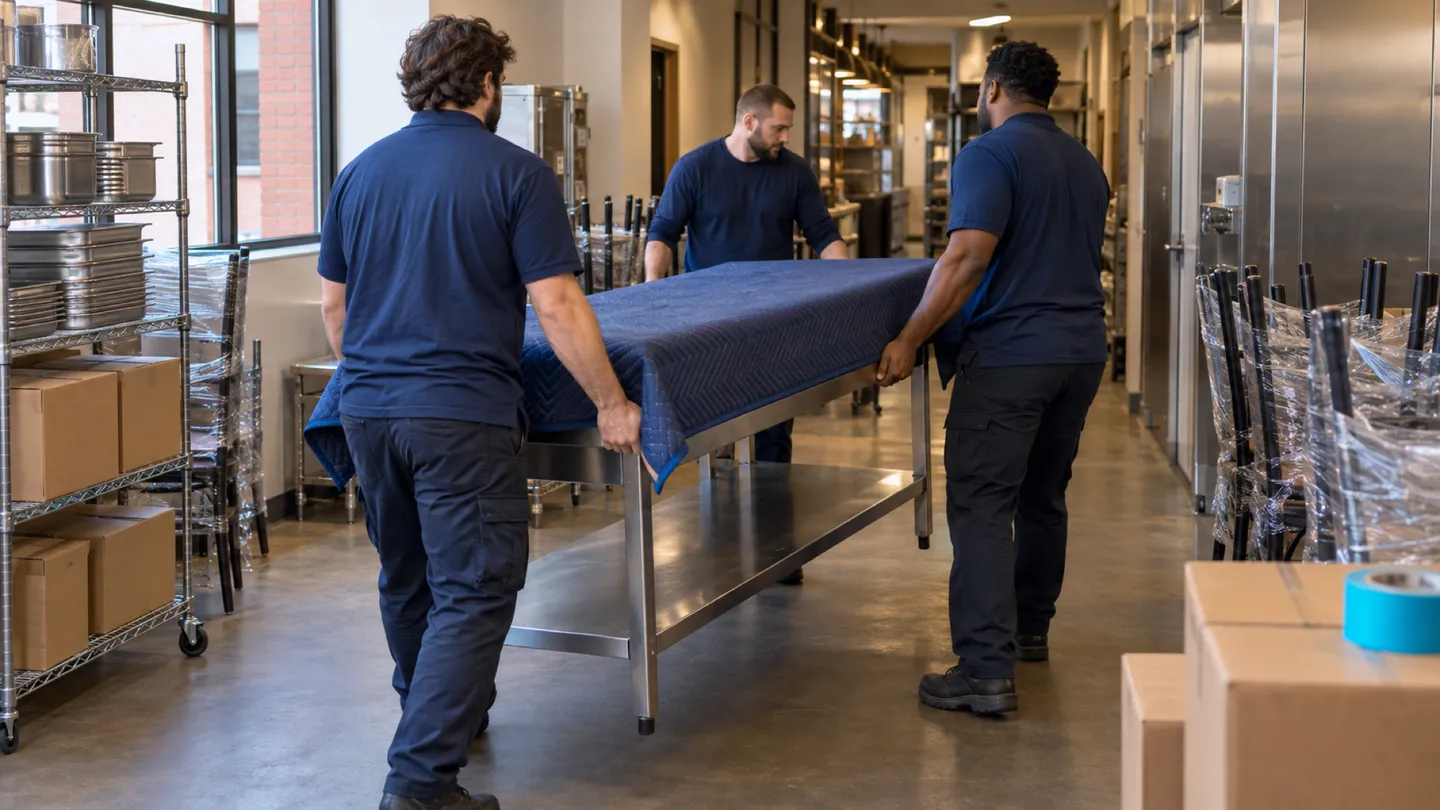
Restaurant Equipment Moving moving in Boston and MetroWest: moving crew at work
  • Licensed & Insured Fully Covered
  • Owner-Operated By Tyler Trefrey
  • 10 States Northeast Served

Start your free commercial move quote

verified For estimate purposes only credit_card_off No credit card required

How We Plan Restaurant Equipment Moving

Plenty of kitchen equipment can ride on a moving truck once it has been released; the work is in the steps around that release. We start with a walk-through with your chef, going piece by piece: stainless worktables, wire shelving, speed racks, dish racks, plug-in reach-ins, countertop mixers and slicers, and the smallwares. Each item gets marked either as ours to carry after release or as the trade's. Ranges, fryers, dish machines, plumbed ice machines, hoods, and walk-ins land on the trade side.

Then the order runs like this. Your kitchen team empties, cleans, and defrosts. The licensed trades disconnect what is connected. Our crew packs smallwares by station, breaks down shelving and bags its parts, pads the released pieces, and loads them in the reverse of the order the new kitchen needs them. At the new address we set each unit at its station on the plan, with room for the trade to reach its connections, and the trades take over for start-up.

Who usually signs off
Restaurant owner or general manager, with the chef identifying movable pieces and the equipment vendors confirming release and setup
Timing that works
Between the trades' release visit at the old kitchen and their start-up visit at the new one, with evening or weekend loading on request.

What typically moves

  • Stainless worktables and equipment stands Undershelves cleared by staff; corners padded, marked for the prep position.
  • Wire shelving, speed racks, and dunnage racks Broken down where the design allows, with posts and clips bagged per unit.
  • Plug-in reach-in refrigerators and freezers Emptied, defrosted, and unplugged by staff; they travel upright and strapped.
  • Countertop mixers, slicers, and food processors Blades and attachments boxed separately; the heavy bases ride on the truck floor.
  • Hotel pans, sheet pans, stockpots, and utensils Packed by line, prep, or dish station so weight never sits on lighter pieces.
  • Dish racks, bus tubs, and drying shelves Kept together by station and labeled for the dish pit.

Access and scheduling

The release list comes before the truck date. Your chef and the trades agree which units are disconnected on which day, and we book our loads after those visits and before the new kitchen's start-up. Smallwares and shelving can move a day or two early, so the new kitchen has shelves up before equipment arrives. Loading after close or on a Sunday can be arranged.

Kitchen equipment is heavy and awkward, so measure the path at both ends: back door, stairs, the turn into the kitchen, and any shared corridor in a mixed-use building. A downtown Boston or Seaport space may need a booked dock and freight elevator and proof of insurance for the building, which we can issue. A reach-in that will not clear a door once its handles and hinges are off goes back to its vendor for advice.

Protection and handling

Stainless is tough, but its corners and handles damage door frames, walls, and other gear. Corners get guards, doors on reach-ins are strapped shut, and loose shelves inside are removed and wrapped. Reach-ins ride upright, never on their backs, and the refrigeration technician tells you how long a unit should stand before it is plugged in again.

Smallwares are packed by weight. Stockpots and sheet pans go in small, strong cartons; ceramics and glass go in divided ones; knives are wrapped and boxed apart with the box marked. Kitchen floors are often slick, so the crew lays runners and takes slow, two-person carries through the back door. Nothing edible rides with us: food and chilled stock stay with your team.

Who does what

Some of this job belongs to other trades. The written plan names each one.

Gas ranges, fryers, ovens, and anything plumbed or hardwired
A licensed gas fitter, plumber, or electrician disconnects and caps the service, then reconnects and tests at the new kitchen. We carry a released freestanding unit on their instructions.
Hoods, walk-ins, dish machines, and ice machines
The hood contractor, refrigeration contractor, and equipment vendors take these out and reinstall them, or the landlord keeps them.
Food, cleaning, and defrosting
Your kitchen team empties, cleans, and defrosts every unit before our crew handles it.

Not part of our work

  • Any gas, water, electrical, or refrigerant work, including capping, reconnecting, or testing.
  • Taking out hoods, walk-ins, or built-in assemblies.
  • Deciding what food or chilled stock can be kept.

Around Boston and MetroWest

Kitchen equipment moves around Boston are shaped by building type. North End and South End kitchens often sit below street level or behind a narrow side door, while Seaport kitchens usually share a dock with offices. Plaza restaurants along Route 9 and Route 1 tend to have a rear door and a landlord's delivery hours.

The crew that shows up

Eastside Movers crew in the snow outside Massachusetts colonials in winter

Restaurant Equipment Moving FAQs

Another question? Call (774) 421-9389.

How do we decide which kitchen units go on the mover's inventory?

Walk the kitchen with your chef and mark each piece. Freestanding and plug-in items, such as worktables, shelving, speed racks, reach-ins, and countertop equipment, can go on our list once they are emptied and released. Anything with a gas, water, or hardwired connection, and anything built in, goes on the trades' list. We check our list against the measured door route.

Can our smallwares be packed while the line is still serving?

Yes, the reserve stock. The chef pulls duplicate pans, spare utensils, banquet pieces, and anything seasonal, and we box them by station. The line keeps what it needs until the last service, and those cartons are packed after close. A label naming the destination shelf saves the receiving staff time on the first morning.

What happens if a released prep unit will not fit through the new kitchen door?

Measure the opening and the turn beyond it before the date, and include handles and legs. Some units clear once doors, casters, or handles come off, which the vendor can advise on. If it still will not fit, the vendor decides how to take it down further, and we adjust the load plan around that.

Should dining tables arrive before the kitchen equipment?

It depends on which entrance the kitchen equipment needs. When everything has to come through the dining room, the kitchen goes first and the tables wait on the truck or come on a second load. Where the kitchen has its own back door, both can go in at once, and shelving and smallwares can be set ahead of the equipment.

Plan your business move

Tell us both addresses, the building rules you know about, and the dates you cannot move. We will send back a written plan and estimate.

Call (774) 421-9389

Mon–Sat 8:00 AM – 5:00 PM

Call Now call 774-421-9389