Commercial Service

Commercial Crating in Boston and MetroWest

A crate sized for the piece and its route, with equipment vendors and exhibit or art staff directing the parts they control.

(774) 421-9389
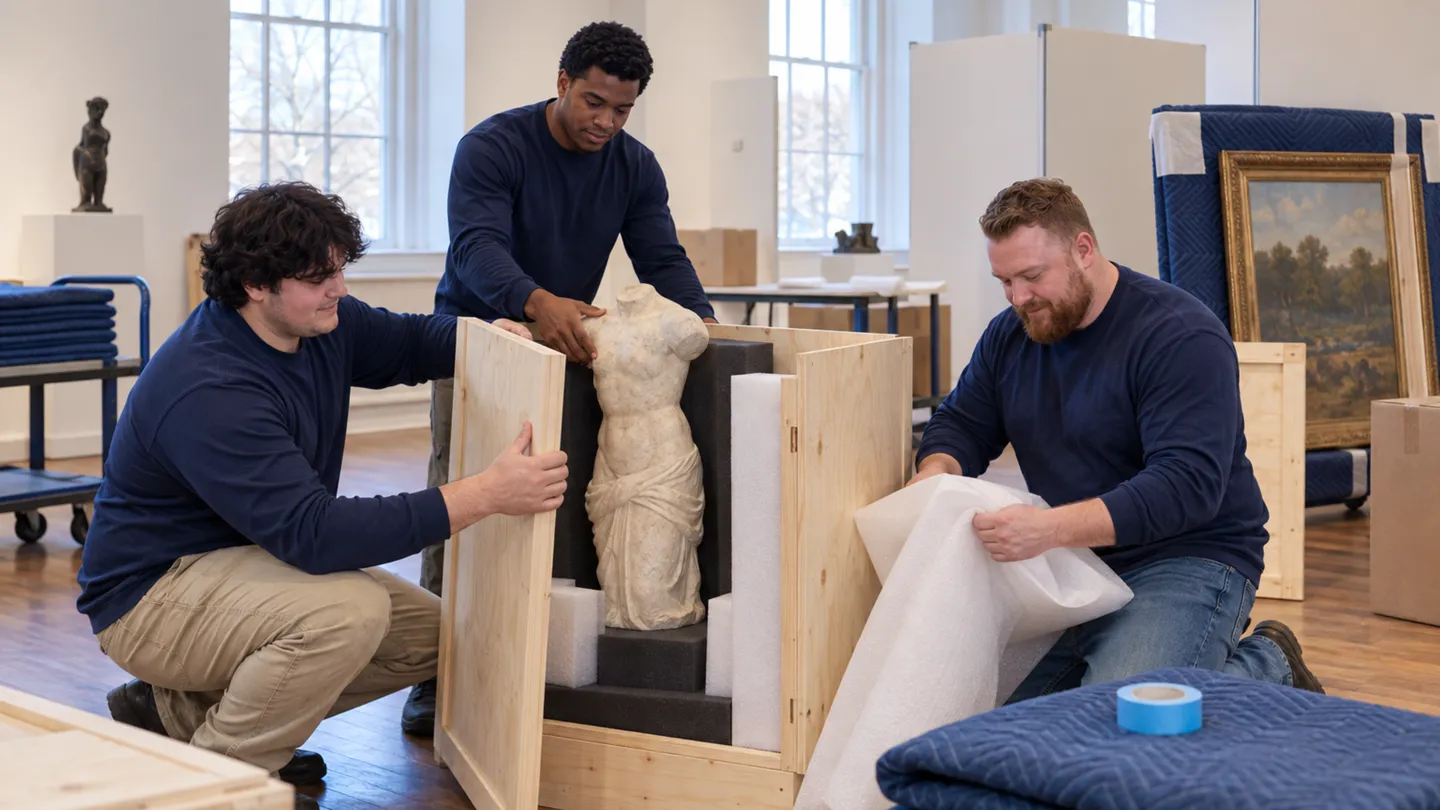
Commercial Crating moving in Boston and MetroWest: moving crew at work
  • Licensed & Insured Fully Covered
  • Owner-Operated By Tyler Trefrey
  • 10 States Northeast Served

Start your free commercial move quote

verified For estimate purposes only credit_card_off No credit card required

How We Plan Commercial Crating

Some pieces need a wooden crate built around them: an exhibit panel, a display case, an instrument, a sculpture, a trade-show element, or framed art that a carton and pads cannot protect. It suits pieces that are fragile, awkwardly shaped, heavy for their size, or traveling a long way. It runs through our custom crating service.

The process has four steps. First, the person responsible for the piece, whether the equipment vendor, the exhibit producer, or the registrar, tells us what can be removed, what has to be secured, where the piece can bear weight, and which surfaces must not be touched. Second, we measure the piece in the form it will travel, plus both buildings' doors, elevators, and turns, because a crate that fits the object but not the service elevator is no use. Third, the crate is built with blocking and cushioning at the approved support points and marked for orientation. Fourth, we move it and set it where your team directs, and that same person decides who opens it. If a crate might later go overseas, say so, since wooden crates crossing borders generally need heat-treated lumber.

Who usually signs off
Facilities manager, exhibit producer, gallery registrar, or operations lead who approves the item list and receiving plan
Timing that works
After the equipment vendor releases a piece or an exhibit closes, with time for measuring and building the crate before loading; evening or weekend work on request.

What typically moves

  • Released instruments and equipment modules Secured by the vendor first; crated around its lifting points.
  • Exhibit panels with brackets or relief Crate sized for the projections; removed brackets bagged with the panel.
  • Display cases and glass panels Glass crated separately where the case comes apart.
  • Framed artwork and mounted prints Orientation and contact surfaces set by your registrar or art contact.
  • Sculpture and models Supported at the bases and points your contact approves.
  • Trade-show elements and presentation models Loose fittings bagged and marked by element.

Access and scheduling

Crating needs floor space and time before the move itself. Tell us where we can measure and build, whether tools and noise are allowed there, and when the piece stops being on display or in use. The vendor's release or the exhibit's closing comes first, and our building time follows.

Send the whole route: from where the piece stands to the loading door, and from the receiving door to its final room. Older Boston galleries and civic buildings often have smaller service doors and elevators than their rooms suggest, while newer Seaport buildings may need the dock booked. Either kind of building may ask for our insurance paperwork, which goes out ahead of the date. If a crate would be too big for the tightest turn, we plan separate crates for removable parts before building anything.

Protection and handling

The key question is where the crate is allowed to touch the piece. A painted frame, a projecting exhibit detail, and an instrument's control panel each need pressure kept off them. The vendor or art contact marks the support points and no-contact surfaces, and the blocking and cushioning are built to those instructions, with loose parts held so they cannot rub the main piece.

The outside is marked with orientation arrows, the destination room, and handling notes. The crate moves as one unit on dollies or with the equipment its weight calls for, and the route is protected at both buildings. At delivery, it is set where your team says, and if the piece needs its registrar, conservator, or technician present for opening, we wait for them.

Who does what

Some of this job belongs to other trades. The written plan names each one.

Instruments with calibrated, powered, or moving parts
Your equipment vendor takes the unit out of service, secures it, gives lifting instructions, and reinstalls and checks it.
Artwork, exhibit objects, and contact materials
Your registrar or art contact approves handling points and materials and directs opening.
Wall-attached cases and suspended displays
Your exhibit installer or contractor releases and reinstalls them.

Not part of our work

  • Taking equipment out of service, calibrating it, or choosing its lifting points.
  • Removing attached displays without the installer.
  • Choosing conservation materials or handling art without its contact's approval.

Around Boston and MetroWest

Crating work in this market often starts in older Boston buildings, such as galleries in the South End's SoWa district, Back Bay, and around the university campuses, where service doors limit crate size. Seaport buildings add dock bookings, while Route 128 and I-495 office parks usually allow ground-level loading.

The crew that shows up

Eastside Movers crew in the snow outside Massachusetts colonials in winter

Commercial Crating FAQs

Another question? Call (774) 421-9389.

Can you size an exhibit crate before the installation team takes the piece apart?

We can start from the installed dimensions and the installer's drawings, but the final size should come from the piece as it will travel. Ask the installer what comes off and where it will go. We then measure the parts that travel and check the crate against both buildings' doors and elevators.

Who decides whether framed art travels inside its existing frame?

Your registrar or art contact. They also mark which surfaces can take contact and which way up it rides. Tell us about loose glazing or projecting ornament before we measure. The same person directs opening and inspection at the other end.

What if the planned crate will not fit a Boston building's freight elevator?

Send the elevator's door opening, cab size, and the tightest corridor turn. We compare them with the crate's outside size, including skids. Depending on the piece and your vendor's instructions, removable parts may get their own crates, or the piece may be crated once it reaches a larger staging area.

Do crates need special lumber if the piece will later ship overseas?

Usually yes. Wooden packaging crossing international borders generally has to be made of heat-treated lumber and stamped to show it, under a standard most countries follow. If the crate might travel abroad later, tell us before we build it, so the wood is chosen accordingly.

Plan your business move

Tell us both addresses, the building rules you know about, and the dates you cannot move. We will send back a written plan and estimate.

Call (774) 421-9389

Mon–Sat 8:00 AM – 5:00 PM

Call Now call 774-421-9389