Retail, Restaurant & Hospitality

Retail Store Moving in Boston and MetroWest

Move display fixtures and SKU-sorted stock through the loading window your landlord allows, from Route 9 centers to Boston storefronts.

(774) 421-9389
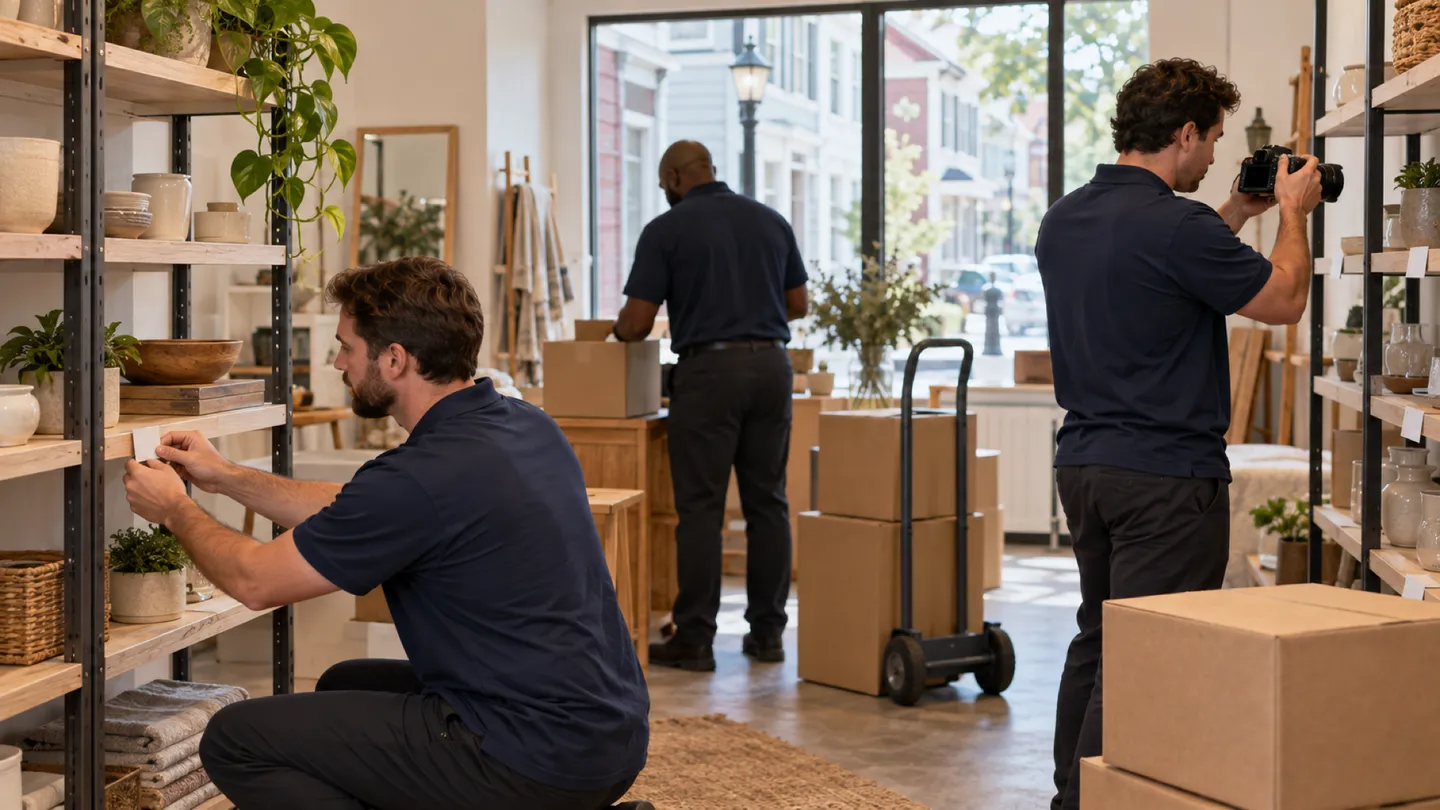
Retail Store moving in Boston and MetroWest: moving crew at work
  • Licensed & Insured Fully Covered
  • Owner-Operated By Tyler Trefrey
  • 10 States Northeast Served

Start your free retail store move quote

verified For estimate purposes only credit_card_off No credit card required

Planning a Retail Store Move

Two parties set the terms of a store move, and neither one is the mover. The landlord, through the mall's tenant coordinator or the building manager, decides when trucks can come, which door they use, and what paperwork has to be on file. The planogram decides where every fixture and every carton ends up. Our job is to get the sales floor from one to the other without losing the connection between a fixture, its hardware, and the stock that lives on it.

Before teardown we photograph each run and tag its uprights, shelves, and bagged hardware with one number, and your staff pull merchandise and pack it by the department and bay it will fill. Cash wraps, tables, mannequins, and back-room shelving travel with the same tags. At the new store the fixtures go in first, set to the plan, so your team can merchandise from the cartons stacked beside each bay. Signs, lighting, and the payment terminals are handled by the people who installed them.

Who usually signs off
Store owner or retail operations manager, with the visual merchandising lead and both landlords approving access and layout
Timing that works
After the last trading day and inside the landlord's move-in window, which in malls and managed centers usually falls after the center closes; after-close or weekend work on request.

What typically moves

  • Freestanding gondola runs and endcaps Photographed, then tagged by run; clips and shelf brackets bagged per section.
  • Tables, nesting plinths, and garment rails Marked for the selling zone on the new floor plan.
  • Glass showcases and jewelry cases Loose glass and shelves come out and ride wrapped; locked cases stay locked.
  • Mannequins and display forms Detachable parts wrapped and kept with their own form.
  • Department-packed merchandise cartons Packed or sorted by your staff; each carton marked with department and bay.
  • Freestanding cash wraps and back-room shelving Counter sections padded and numbered; stockroom shelving broken down and bagged.

Access and scheduling

Get the move-in rules from both properties before picking a date. Enclosed malls on Route 9 in Natick and Framingham typically route tenant deliveries through a service corridor and receiving door, often after the center closes, and want an insurance certificate listing the landlord before the first truck. We provide that certificate on request. Outlet and lifestyle centers along I-495, such as the Wrentham area, may use rear service lanes with set hours.

Newbury Street and Beacon Hill shops are different. Many sit a half-flight up or down from the sidewalk in converted row houses, with no dock and a front door that doubles as the loading door. There, the truck needs legal curb space, sometimes a street-occupancy permit from the city, and fixtures may need to come apart smaller than usual to clear the stoop. Where the landlord allows it, the crew can work an evening or a weekend on request.

Protection and handling

Fixtures get damaged at the edges and lost in the hardware. Painted uprights and laminate shelf edges get corner guards, glass comes out of cases and travels on edge in padded cartons, and each run's clips and brackets go into a bag taped to its first upright. Mannequins ride in their own padded area, away from metal fixtures.

Merchandise is packed by your system, not ours. If your team works by department, style, or SKU, we keep cartons grouped that way on the truck and at the destination, and heavy goods never go in the same carton as fragile ones. Where a service corridor opens onto a finished sales floor, runners go down and door frames are padded before the first load comes through.

Who does what

Some of this job belongs to other trades. The written plan names each one.

Illuminated signs, track lighting, and hardwired displays
Your sign company or electrician takes these down and reinstalls them, including any permit the new sign needs. We carry released pieces.
Payment terminals, registers, and the store network
Your point-of-sale provider or IT contact removes, reinstalls, and tests them. We move the cleared counters.
Wall-anchored fixtures and landlord-owned millwork
The landlord decides what can leave, and its approved installer takes down anything fastened to the building.

Not part of our work

  • Counting merchandise or reconciling it against the store's inventory records.
  • Electrical work, sign installation, or removing fixtures anchored to the building.

Around Boston and MetroWest

Boston-area retail comes in three shapes. The enclosed malls and big-box plazas of the Route 9 Golden Triangle in Framingham and Natick, the outlet and lifestyle centers along I-495, and the street-front shops of Newbury Street, Downtown Crossing, Coolidge Corner, and Wellesley's town center. Each one sets its own loading rules, and the lease usually says which.

The crew that shows up

Eastside Movers crew in the snow outside Massachusetts colonials in winter

Retail Store Moving FAQs

Another question? Call (774) 421-9389.

Can we bring stock into a Route 9 mall after the shops close?

Usually, if the tenant coordinator books it. Many enclosed malls prefer tenant move-ins after the center closes, through the service corridor, with a certificate of insurance on file and someone from the store meeting the crew at the receiving door. Ask management for its move-in form early; we can work that window on request once they confirm it.

How do you keep our gondola parts matched to the right display?

Every run is photographed before teardown, then its uprights, shelves, base decks, and hardware bag get the same number. The number goes on the new floor plan next to the bay the run will become. If your merchandising lead is changing heights or shelf counts, mark that on the plan before teardown so extra parts are set aside.

What should we do with merchandise that has several sizes under one style?

Pack it the way you replenish. If your team restocks by style and size, have them pack that way and write the grouping on each carton, and we keep those cartons together on the truck and stack them by the bay at the new store. Counts and inventory adjustments stay with your team.

Our Newbury Street shop has no loading dock. What has to be checked?

The stoop, the door, and the curb. Measure the front steps, the door opening, and the turn inside against the biggest fixture section, and check whether a garden-level shop has a rear alley door. Ask the city whether the truck needs a street-occupancy permit for the day. Large fixtures may need to come apart further to fit.

Plan your business move

Tell us both addresses, the building rules you know about, and the dates you cannot move. We will send back a written plan and estimate.

Call (774) 421-9389

Mon–Sat 8:00 AM – 5:00 PM

Call Now call 774-421-9389