Retail, Restaurant & Hospitality

Furniture Store Moving in Boston and MetroWest

Keep sale-ready floor models distinct from warehouse stock while exposed finishes are pad-wrapped and each piece follows your destination plan.

(774) 421-9389
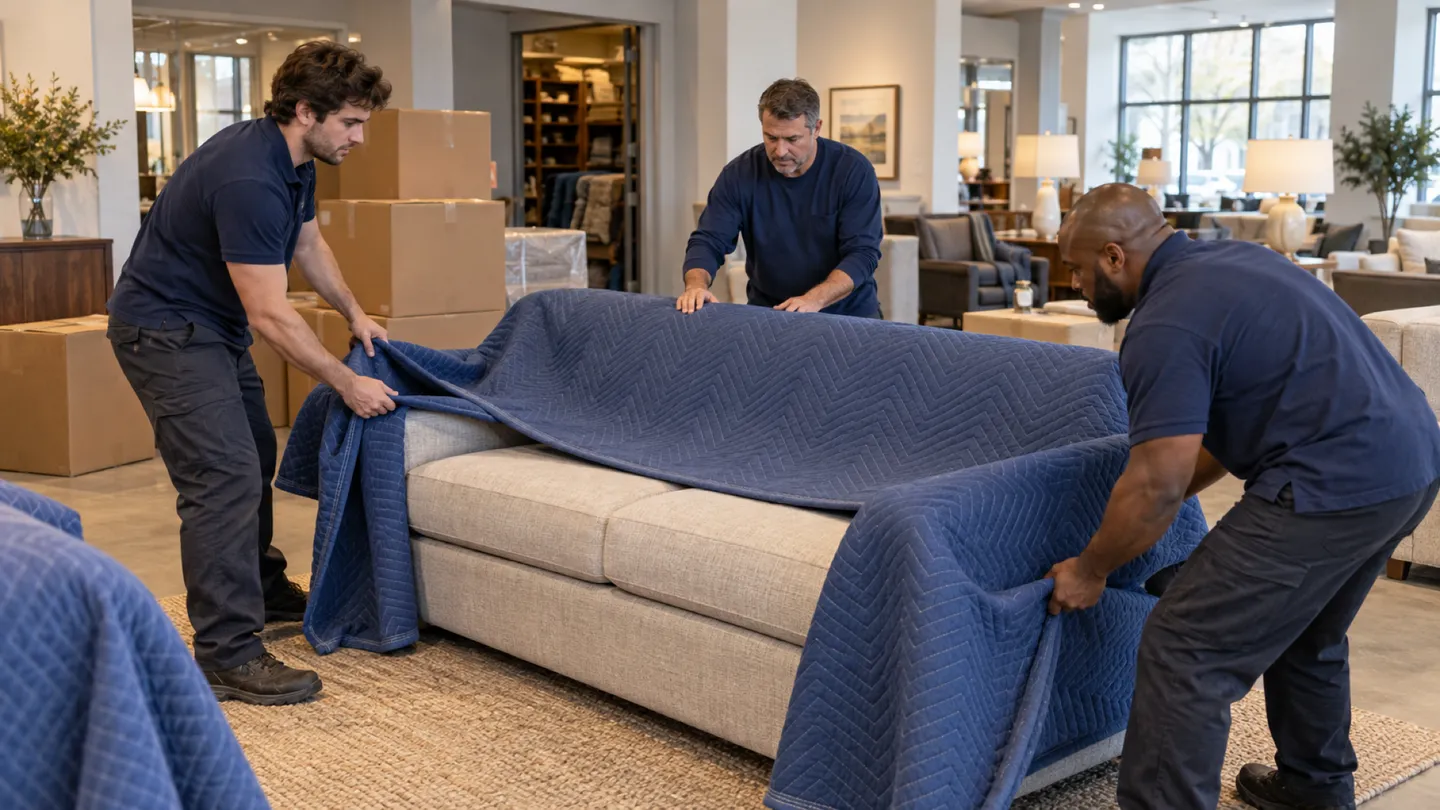
Furniture Store moving in Boston and MetroWest: moving crew at work
  • Licensed & Insured Fully Covered
  • Owner-Operated By Tyler Trefrey
  • 10 States Northeast Served

Start your free furniture store move quote

verified For estimate purposes only credit_card_off No credit card required

Planning a Furniture Store Move

A furniture store is a moving company's normal cargo multiplied by a showroom, and the hard part is keeping it sorted. There are floor models customers have sat on, with tags and condition notes; boxed stock in the warehouse under the manufacturer's labels; customer orders already sold and waiting for delivery; and clearance pieces that may never make the trip. If those groups mix on a truck, a sold sofa ends up on the new sales floor and a scuffed floor model ends up in the stockroom.

We start from your lists. Your stock controller marks each piece as display, stock, sold, or staying behind, and the showroom lead marks where each display vignette goes in the new room. Our crew pad-wraps the exposed pieces one vignette at a time, tags them to the new floor plan, and loads them apart from the boxed stock. Sold orders stay out of our loads unless you tell us otherwise. The count stays with your team.

Who usually signs off
Store owner or operations manager, with the stock controller approving the inventory list and showroom lead setting the new floor plan
Timing that works
Around the store's delivery schedule: pending customer orders go out first, then floor models after the last sales day; evening or weekend loading on request.

What typically moves

  • Floor-model sofas, sectionals, and recliners Cushions ride with their frame; power recliners are unplugged and cords tied off.
  • Dining tables, leaves, and chair sets Leaves and hardware bagged with their table; chairs wrapped in stacks by set.
  • Bedroom sets, headboards, and casegoods Drawers taped shut or removed; mirrors come off dressers and ride apart.
  • Glass and stone tabletops Carried on edge in padded cartons, never flat under other pieces.
  • Boxed warehouse stock Kept under the manufacturer's labels and delivered to the stockroom bays.
  • Area rugs, lamps, and accent pieces Rugs rolled and tagged by bay; lamps and shades boxed separately.

Access and scheduling

The store's delivery calendar comes first. Customer orders that were sold before the move should leave on your own delivery runs, so they are not mixed into the relocation. Then the warehouse stock moves, and the showroom goes last, after the final sales day, often that night or the following Sunday.

Furniture showrooms around here are often big-box units on Route 9 in Framingham and Natick or along Route 1 in Norwood and Dedham, with a rear receiving door or a dock shared with other tenants. Ask each landlord for its dock hours and whether it wants a certificate of insurance on file; we can issue one on request. A smaller city showroom may load at the curb, and a sectional that fit through the old door may need its legs or arms off to clear the new one, so measure both.

Protection and handling

At showroom volume, wrapping is the job. Each upholstered piece gets moving pads first, then stretch wrap over the pads, never directly against leather or fabric. Wood casegoods get pads on every corner, table leaves and glass tops travel on edge, and legs that unscrew are removed and bagged with the piece.

We wrap and tag one vignette at a time, so a piece never loses its tag under the wrapping. Boxed stock is loaded as boxed stock, stacked by weight with the heaviest cartons low. Runners cover the new showroom floor from the receiving door to the vignettes. If a carton arrives damaged, we set it aside where your receiving lead asks and point it out; the store decides whether it goes back to the supplier.

Who does what

Some of this job belongs to other trades. The written plan names each one.

Stock count, sold orders, and clearance decisions
Your stock controller reconciles counts and decides what is sold, kept, or cleared. We move pieces under your labels.
Wall-mounted displays and built showroom fixtures
Your fixture installer takes down anything fastened to the building, with the landlord's approval.
Power-recliner and adjustable-base service
The manufacturer's service rep or your technician handles repairs and resets. We unplug, pack, and carry.

Not part of our work

  • Counting stock, updating orders, or deciding what a damaged piece is worth.
  • Removing fixtures fastened to the building or repairing powered furniture.

Around Boston and MetroWest

Most furniture retail in this market sits on the big commercial roads: Route 9 through Framingham and Natick, Route 1 through Norwood and Dedham, and the plazas off I-495 in Milford and Bellingham. Those units usually have a rear receiving door; city showrooms in Boston and Cambridge more often load at the curb.

The crew that shows up

The Eastside Movers team gathered on an indoor staircase

Furniture Store Moving FAQs

Another question? Call (774) 421-9389.

How will our floor-model sofa stay separate from boxed copies of the same style?

By tag and by truck position. The floor model is tagged for its showroom spot and loaded with the other display pieces, while boxed copies keep the manufacturer's labels and ride in the stock section of the load. At the new store they go to different doors or zones. Your controller checks both at the other end.

Can we keep selling from the showroom while warehouse stock is being moved?

Usually yes, if the warehouse has its own door. We move stock first through the receiving side while the showroom stays open, then move the display floor after the last sales day. If customers and our carts would share an entrance, move the warehouse outside store hours or on a weekend.

Should leather floor models be shrink-wrapped for the move?

Not directly. Plastic against leather can trap moisture and mark the finish, so leather and upholstered pieces get moving pads first, with stretch wrap over the pads to hold them. Tell us which pieces are leather, suede, or delicate fabric when you send the display list, and we plan the pads for them.

Who checks condition when boxed stock reaches the new receiving bay?

Your receiving lead, against the store's records. If we see a crushed or torn carton while handling it, we point it out and set it aside where your lead asks. Whether it is opened, returned to the supplier, or sold is the store's call.

Plan your business move

Tell us both addresses, the building rules you know about, and the dates you cannot move. We will send back a written plan and estimate.

Call (774) 421-9389

Mon–Sat 8:00 AM – 5:00 PM

Call Now call 774-421-9389