Education, Civic & Community

Church Moving in Boston and MetroWest

Pews a contractor has unbolted, hymnals, the fellowship hall, the nursery, and parish offices, moved on weekdays between Sunday services.

(774) 421-9389
Church moving in Boston and MetroWest: moving crew at work
  • Licensed & Insured Fully Covered
  • Owner-Operated By Tyler Trefrey
  • 10 States Northeast Served

Start your free church move quote

verified For estimate purposes only credit_card_off No credit card required

Planning a Church Move

A church's calendar runs backward from most clients'. Sunday is the day nothing can move, and weekdays are open, as long as the calendar has no funerals, weddings, food pantry days, or evening groups in the way. Many congregations move one piece at a time: the offices first, then the fellowship hall and classrooms, and the sanctuary last, in the week between two Sundays.

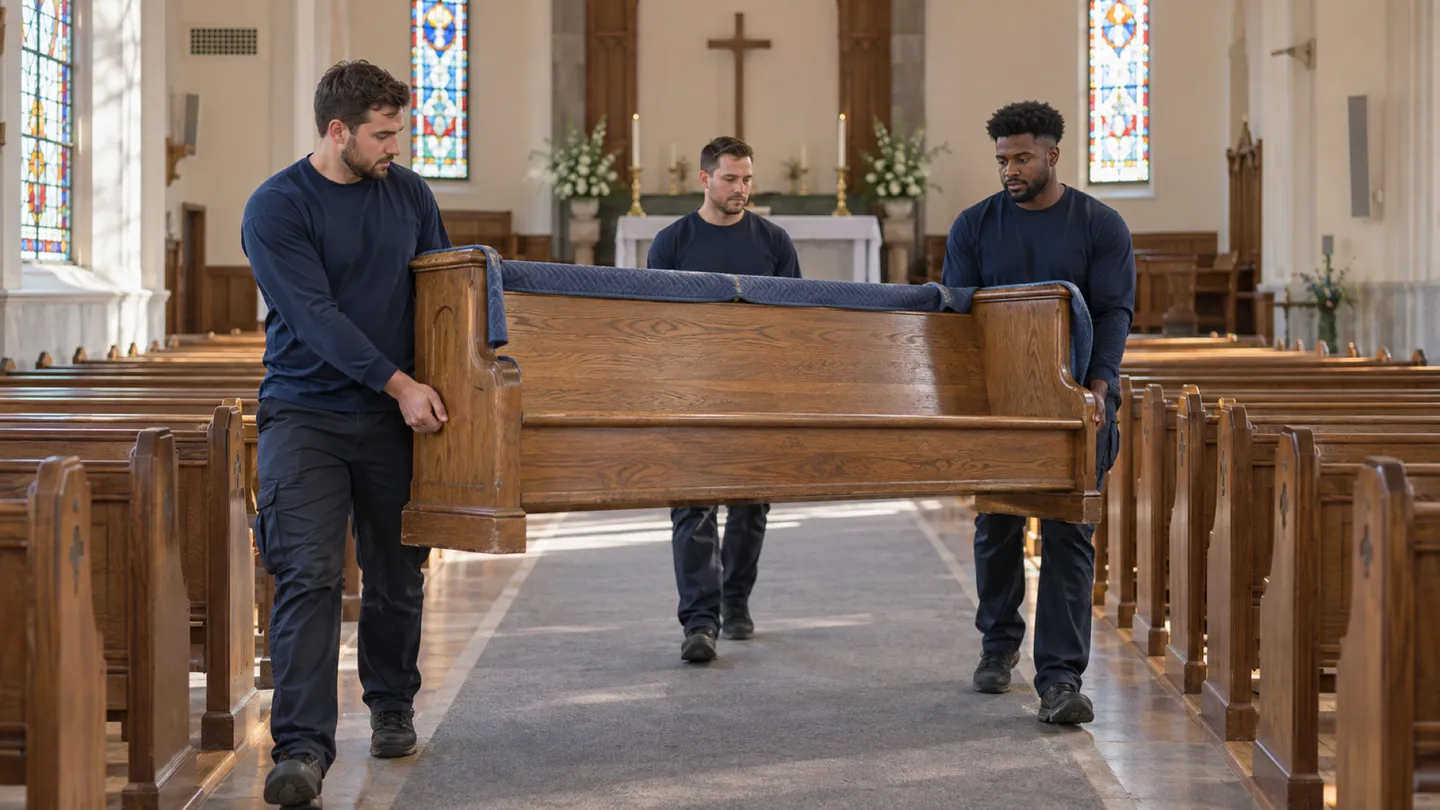
Sanctuaries hold the hardest items. Pews are usually bolted to the floor, so a contractor unbolts them and our crew carries them out on edge and sets them at the new building for the contractor to anchor. Pianos go through our piano moving service, while a pipe organ is the organ builder's work from start to finish. Altar furnishings, vessels, vestments, and anything consecrated are handled by the clergy or altar guild in the way the tradition requires, and the crew carries what they choose to hand over. Around the sanctuary, we move hymnals and pew racks, the pulpit and lectern where they are freestanding, the fellowship hall's tables and chairs, Sunday school rooms, the nursery, and the parish office.

Who usually signs off
Pastor, parish administrator, or facilities chair, with the church's governing body approving the move when required
Timing that works
Monday through Friday, between one Sunday's services and the next, checked against weddings, funerals, and weekday programs on the parish calendar.

What typically moves

  • Pews once the contractor has unbolted them Carried on edge with padded ends, numbered by row, and set for the contractor to anchor at the new sanctuary.
  • Hymnals, Bibles, and pew racks Boxed by row or section, so volunteers can refill pew racks quickly.
  • Freestanding pulpit, lectern, and communion rail sections Moved when the clergy release them; anything fixed stays for the contractor.
  • Fellowship hall tables, stacking chairs, and kitchen carts Counted and moved as a set, since coffee hour needs them the first Sunday.
  • Sunday school rooms and the nursery Child-size tables, cribs, and toys boxed by room and labeled for the new rooms.
  • Parish office desks, files, and the records safe Office furniture moved; the safe goes with a safe mover if it is too heavy.

Access and scheduling

Pick the week between two Sundays, then check the parish calendar for funerals, weddings, food pantry days, and weekday groups. Book the pew contractor and the organ builder, if needed, before our date. Weekday moves suit most churches, and we can work a Saturday on request when the calendar allows.

New England churches bring their own access problems: stone steps, narrow front doors, a sanctuary up a flight from the street, and a hall in the basement. Village-center churches in Wellesley, Needham, Natick, and Franklin often have limited parking, and in Boston neighborhoods the truck may need curb space held by the city. Many older buildings have no elevator. Before the date we walk both buildings and check the longest pew against each doorway, landing, and stair turn. If a diocese or insurer asks for our certificate of insurance, we send it on request.

Protection and handling

Pews are long, heavy, and old, and their ends and arm rests are carved or shaped. We pad every end, carry pews on edge with enough people to keep them level, and keep them numbered so the rows go back in order. Floors in old sanctuaries are often wood or tile, so the route gets runners, and stone steps get pads at the edges.

Anything sacred is handled by the clergy or altar guild, not by the crew: vessels, the tabernacle, relics, vestments, and consecrated items. Stained glass stays with a glazier. Sheet music and choir robes are boxed by the choir director. Parish records are packed by the office staff, and the parish office computers are unplugged, padded, and set up at the new office; the church's IT volunteer handles email and the network.

Who does what

Some of this job belongs to other trades. The written plan names each one.

Pews bolted to the floor
A contractor unbolts them at the old sanctuary and anchors them at the new one; we carry them in between.
Pipe organ
An organ builder takes it apart pipe by pipe and rebuilds and voices it in the new space.
Stained glass windows
A stained-glass studio removes and reinstalls them.
Altar furnishings, vessels, and consecrated items
The clergy or altar guild handles them as the tradition requires.

Not part of our work

  • Unbolting or anchoring pews, or dismantling a pipe organ.
  • Handling consecrated or sacred items without the clergy's direction.

Around Boston and MetroWest

Greater Boston is full of churches in older buildings: brick and stone churches in Boston neighborhoods, white clapboard meetinghouses on town greens in MetroWest and the I-495 towns, and newer churches in former office or retail buildings along Route 9 and Route 1. Congregations that merge or move into a shared building are common, and older buildings often mean stairs and narrow doors.

The crew that shows up

Two Eastside Movers crew members outside a client's red front door

Church Moving FAQs

Another question? Call (774) 421-9389.

Can a church move without missing a Sunday service?

Usually, yes. Most churches move on weekdays between two Sundays, starting with the offices and hall and moving the sanctuary last. If the new building is not ready for a service, some churches hold one Sunday in the hall or a borrowed space, which the pastor or council decides.

Who takes up the pews and puts them down again?

A contractor, since pews are usually bolted to the floor. The contractor unbolts them at the old sanctuary, we carry them on edge with padding and set them by row at the new one, and the contractor anchors them. Book the contractor before the moving date.

Can you move our piano and pipe organ?

We can take the piano, as a piano moving job. The pipe organ is another matter: it has to be dismantled, moved, and reinstalled by an organ builder, and that often takes weeks. Talk to the organ builder early, since their schedule may set the timing for the sanctuary move.

How are altar items and sacred objects handled during the move?

By the clergy or altar guild, in the way the church's tradition requires. The crew does not handle vessels, the tabernacle, relics, vestments, or consecrated items unless the clergy hand them to us and tell us how. Many churches move those items themselves in a separate trip.

Plan your business move

Tell us both addresses, the building rules you know about, and the dates you cannot move. We will send back a written plan and estimate.

Call (774) 421-9389

Mon–Sat 8:00 AM – 5:00 PM

Call Now call 774-421-9389